




Japanese music instruments
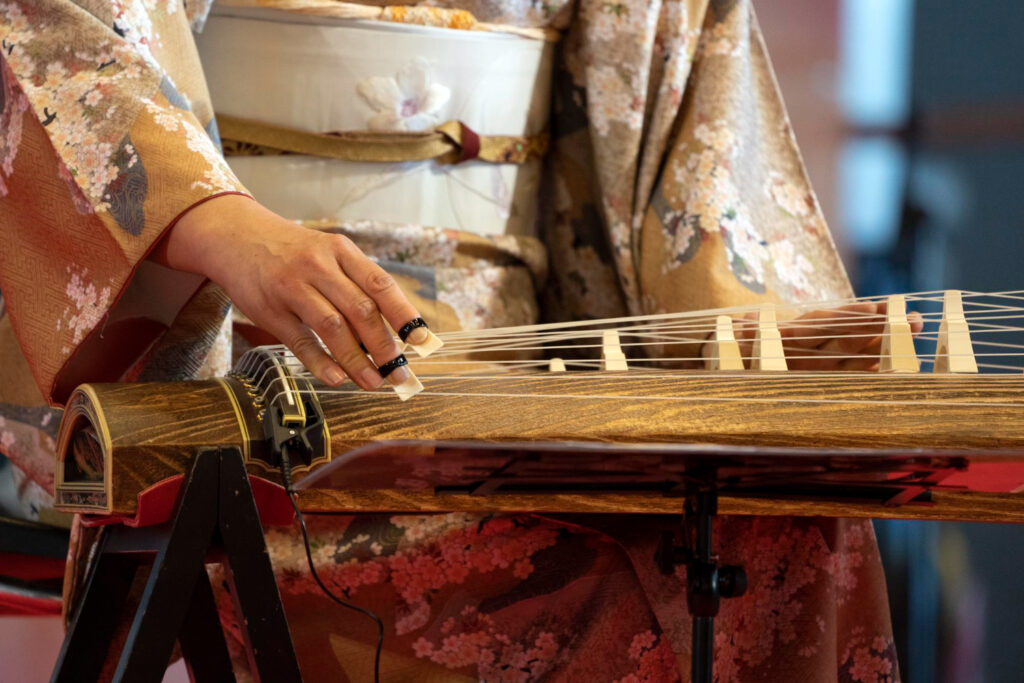
Koto
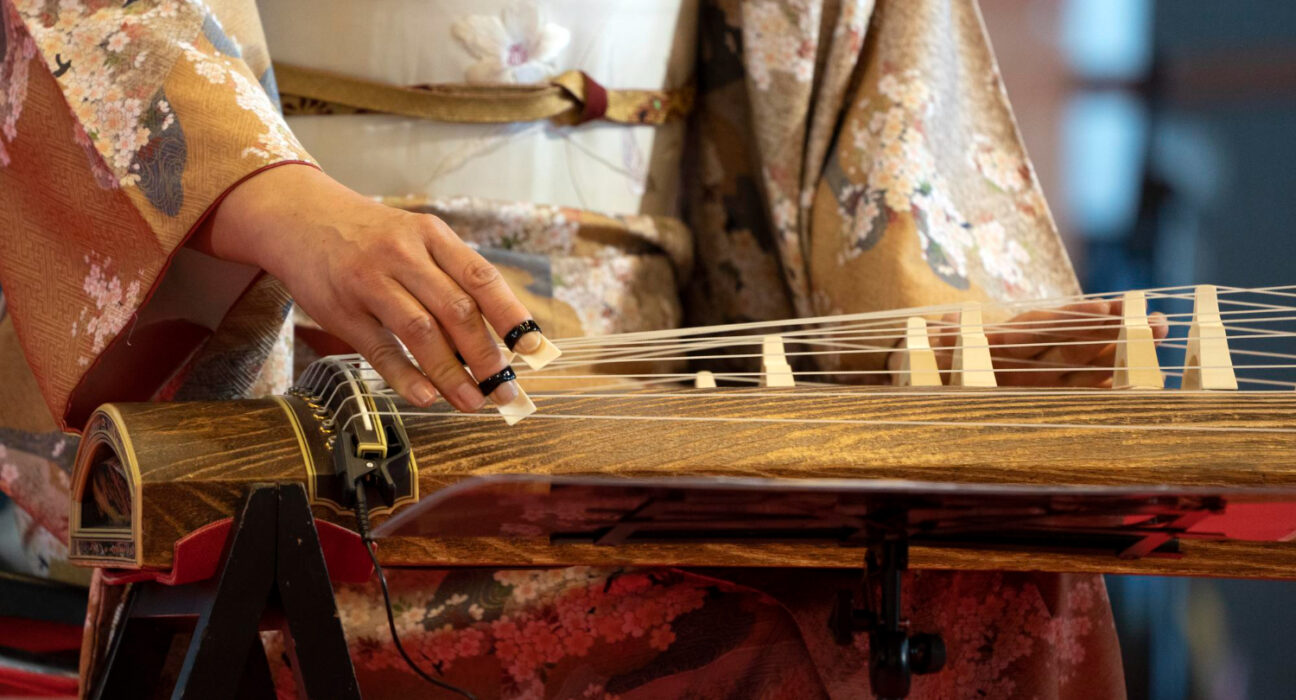
Koto is a traditional and national Japanese stringed musical instrument.
It is made of kiri wood: the bridges used to be made of ivory, but are nowadays made of plastic (rarer of wood), the strings (of which there are 13 in the traditional, or 17, 20, 21, even 25 in the newer versions of the instrument) are made of either plastic or silk.
The body of koto resembles the shape of a dragon; there is a traditional name for every part of the instrument:
• the top (dragon’s shell) – the Asian dragon is believed to have a shell like that
• the bottom (dragon’s stomach)
• the top end of the instrument (dragon’s head) which consists of:
* dragon’s horns (the saddle of the bridge)
* dragon’s tung
* dragon’s eyes (the holes for strings)
* dragon’s forehead (the space above the bridge)
• the other end (dragon’s tail)
• the string nut (cloud horn)
…
Koto is played by placing the instrument on the floor, neeling and then using three finger picks (on thumb, index, and middle finger) to pluck the strings.
If needed, a player may adjust the pitch (tuning) of the strings by moving the white bridges.
some of the best and the most popular koto players are: Reiko Obata, Miya Masaoka, Kazue Sawai, and Michiyo Yagi.
Today, koto is used in music genres such as Jazz, experimental, and even Pop.
Nohkan
The nohkan is a Japanese bamboo flute.
It was first created in the fifteenth century by Kan’ami and Zeami, and has been used in Noh and Kabuki theater.
The instrument is made of split and tapered strips of either smoked or burned bamboo, which is then glued together to form a tapering conical bore.
In order to achieve better acoustics, The split strips of bamboo are reversed (the hard bamboo surface inside).
It is the conical bore and its unique internal restriction of about 2/3 mm (called nodo – throat) which gives the nohkan its distinctive high-pitched sound by using the venturi effect.
It has seven holes which are used to play; the player covers the holes thus blocking the airway to them, and leaves the needed ones uncovered so that the air can go through and produce the tone.
Shakuhachi
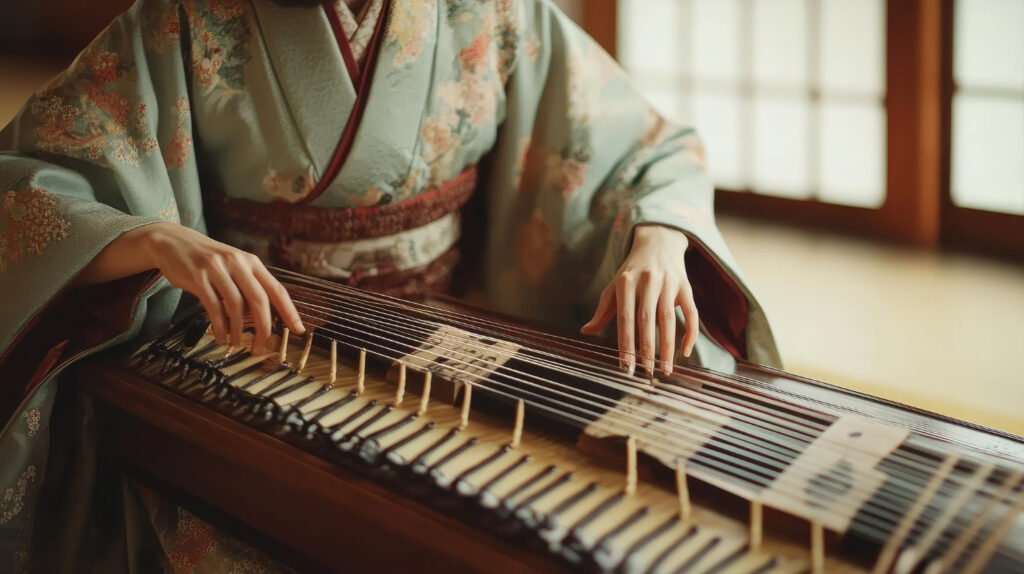
The shakuhachi is a very popular Japanese end-blown flute.
It has arrived to Japan from China in the sixth century.
Shakuhachi got its name from its length – 1.8 shaku = almost 55 cm (the standard length of the instrument).
It is traditionally made of bamboo, but the plastic, pvc, and wood versions exist, too.
Shakuhachi is the extremely versatile instrument – a professional player can produce any pitch they want, and play a wide range of genres (e.g., ensemble, folk, jazz).
This is possible due to the various fingering and blowing techniques (e.g., a player might cover the holes fully, or only partially, blow in different angles to achieve different pitches).
Shakuhachi has 5 holes which are used to play; a player covers the holes thus blocking the airway, and leaves the desired one[s] uncovered so that the air goes through and makes the sound.
This instrument is very popular even outside of the japanese culture; even American players play it (the first one was Riley Lee).
It is also used in modern music genres (electronica, pop-rock, jazz…).
The notable Shakuhachi players are Henry Johnson, Iwamoto Yoshikazu, Tsukitani Tsuneko, Riley Lee…
Shamisen
The Shamisen is a Japanese three-stringed musical instrument.
It originated from the Chinese instrument “sanxian”, and is similar to the guitar/banjo construction-wise.
There are different versions of the Shamisen (hosozao –small, chuzao – medium, futozao – big…), and all of them are used for playing different genres.
The instrument consists of
• the body (do) – hollow and covered with the cat/dog skin, or paper/plastic
• the neck (sao) – usually divided into 3/4 pieces which lock together. It acts as the anchor for the strings
• the pegs for winding the strings – long, thin, and hexagonal; made of ivory/wood/plastic.
• the strings – made traditionally of silk, or nowadays nylon.
The strings are plucked either with the fingers or plectrum “bachi” (depending on the genre and the version of the instrument), which comes in different sizes and is made of plastic/wood/ivory.
The shamisen is used for playing modern genres nowadays; Takeharu Kunimoto plays bluegrass music on it, Michihiro Sato plays free improvisations, the band Zenitrash plays metal on it, Hiromitsu Agatsuma plays jazz, funk, electro and traditional Japanese styles…