




Indian wedding custom
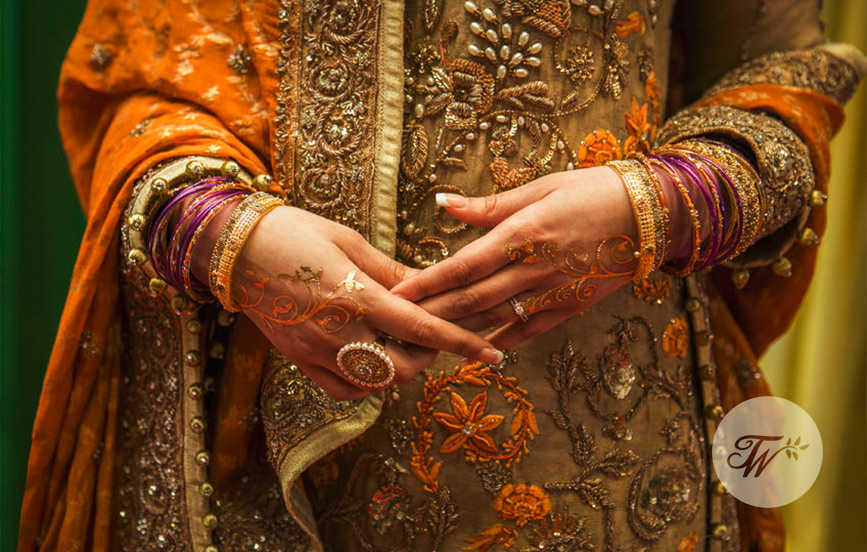
Indian weddings take anywhere from five minutes to several days, depending on region, religion, and a variety of other factors. Due to the diversity of Indian culture, the wedding style, ceremony and rituals may vary greatly amongst various states, regions, religions and castes. In certain regions, it is quite common that during the traditional wedding days, there would be a tilak ceremony (where the groom is anointed on his forehead), a ceremony for adorning the bride’s hand and feet with henna (called mehendi) accompanied by Ladies’ Sangeet (music and dance), and many other pre-wedding ceremonies.
Another important ceremony followed in certain areas is the “Haldi” program where the bride and the groom are anointed with turmeric paste. All of the close relatives make sure that they have anointed the couple with turmeric. In certain regions, on the day of the wedding proper, the Bridegroom, his friends and relatives come singing and dancing to the wedding site in a procession called baraat, and then the religious rituals take place to solemnize the wedding, according to the religion of the couple.
While the groom may wear traditional Sherwani or dhoti or Western suit, or some other local costume, his face, in certain regions, is usually veiled with a mini-curtain of flowers called sehra. In certain regions, the bride (Hindu or Muslim) always wears red clothes, never white because white symbolizes widowhood in Indian culture. In Southern and Eastern states the bride usually wears a red Sari, but in northern and central states the preferred garment is a decorated skirt-blouse and veil called lehenga. After the solemnization of marriage, the bride departs with her husband. This is a very sad event for the bride’s relatives because traditionally she is supposed to permanently “break-off” her relations with her blood relatives to join her husband’s family. Among Christians in the state of Kerala, the bridegroom departs with the bride’s family.
The wedding may be followed by a “reception” by the groom’s parents at the groom’s place. While gifts and money to the couple are commonly given, the traditional dowry from the bride’s parents to the couple is now officially forbidden by law.
Source: Wikipedia




shawnkynapa
18/02/2016Thanks a bunch for sharing this with all of us you actually know what you’re talking about! Bookmarked. Kindly also visit my site =). We could have a link exchange agreement between us!
shawnkynapa
TW admin
18/02/2016Hi Shawkynapa, you are welcome! We are interested in a link exchange of course, just please send us your backlinks and will then send ours. You can contact us via contact form on our contact page.
JoniPDoney
18/02/2016Unquestionably imagine that that you just said.
Your favorite justification seemed to be at the internet the simplest thing to
consider of. I believe that for you, I certainly get annoyed at the same time as folks think about issues that they can just don’t know about.
You managed to hit the nail upon the most notable and defined out the whole
thing without having need side-effect , other folks can have a signal.
Will probably be again to obtain additional.
Thanks